
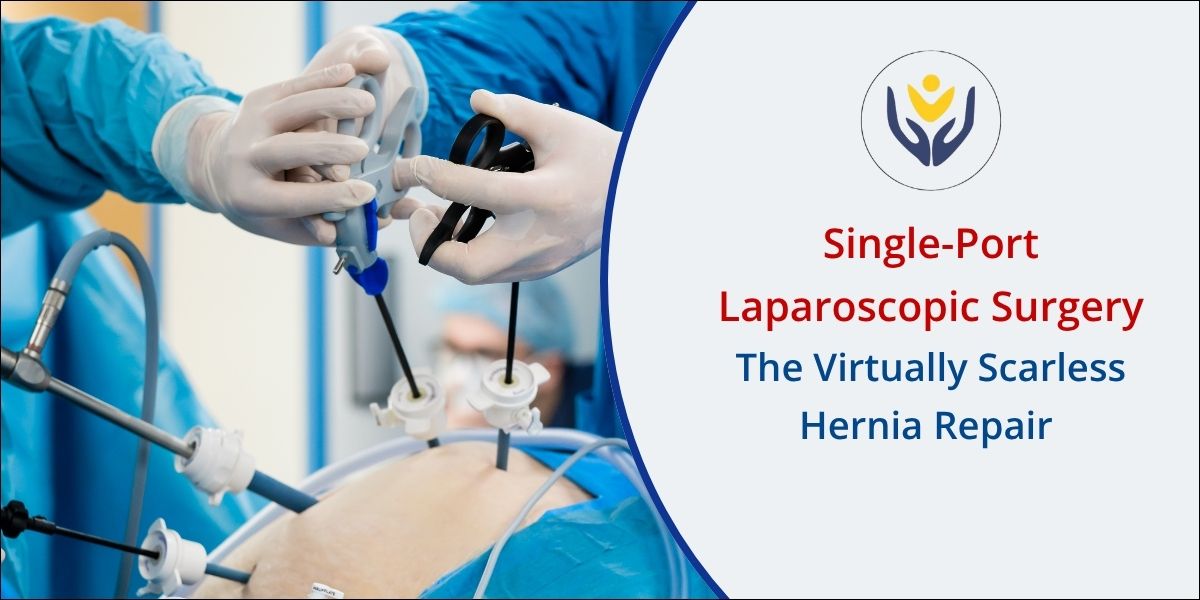
A hernia can be uncomfortable, painful, and sometimes worrying. Many people delay hernia treatment because they are concerned about surgery, recovery time, or visible scars. But advances in minimally invasive surgery have changed the way many hernias can be treated.
Single-port laparoscopic surgery is one such advanced technique. It allows a surgeon to perform hernia repair through a single small incision, usually around the belly button. Because the incision can be hidden within the natural contours of the navel, the final scar may be very difficult to notice. This is why the procedure is often described as virtually scarless hernia repair.
What Is a Hernia?
A hernia occurs when an internal organ or tissue pushes through a weak area in the surrounding muscle or abdominal wall. It commonly appears as a swelling or bulge that may become more noticeable while coughing, lifting something heavy, standing, or straining.
Common types include:
- Inguinal hernia
- Umbilical hernia
- Incisional hernia
- Femoral hernia
- Ventral hernia
Symptoms can range from a painless lump to discomfort, heaviness, or pain, especially during physical activity.
What Is Single-Port Laparoscopic Hernia Surgery?
Traditional open hernia surgery may require a larger incision directly over the hernia. Conventional laparoscopic surgery generally uses several small incisions to insert a camera and surgical instruments.
Single-port laparoscopic surgery, also called single-incision laparoscopic surgery, aims to perform the procedure through one small incision.
The surgeon inserts a camera and specially designed instruments through this access point. The hernia is carefully repaired, and in many cases, a surgical mesh is placed to strengthen the weakened area and reduce the risk of recurrence.
The exact technique depends on the type, size, location of the hernia, previous surgeries, and overall health of the patient.
Why Is It Called a Virtually Scarless Procedure?
The term “scarless” can sound like there will be absolutely no scar, but this is not technically correct. Any surgical incision can leave a scar.
The advantage of single-port surgery is that there is only one small incision, often positioned at or near the belly button. Once healed, the scar may blend with the natural shape of the navel and become less noticeable.
For patients who are concerned about the cosmetic appearance after hernia surgery, this can be an important benefit.
Benefits of Single-Port Laparoscopic Hernia Repair
Depending on the patient’s condition and the surgeon’s assessment, single-port laparoscopic hernia repair may offer several advantages:
1. Smaller Number of Incisions
Unlike conventional laparoscopic surgery, which generally uses multiple access points, single-port surgery uses one main incision.
2. Better Cosmetic Appearance
The incision can often be placed within the belly button, making the resulting scar less visible after healing.
3. Minimally Invasive Approach
The technique uses small surgical access rather than a larger open incision, which may contribute to reduced tissue trauma.
4. Potentially Faster Recovery
Many patients can return to normal daily activities relatively quickly, although recovery varies according to the type of hernia and individual health.
5. Reduced Postoperative Discomfort
Some patients may experience less discomfort compared with certain open surgical approaches. However, pain levels can vary from person to person.
Is Single-Port Surgery Suitable for Everyone?
Not necessarily. Single-port laparoscopic hernia surgery is not the right choice for every patient.
The surgeon needs to evaluate the hernia carefully before recommending the procedure. Factors such as a very large hernia, complicated or recurrent hernia, previous abdominal operations, obesity, other medical conditions, or emergency complications may influence the choice of surgical technique.
A proper consultation helps determine whether single-port laparoscopic hernia repair or another surgical approach would provide the safest and most effective result.
What Is Recovery Like?
Recovery depends on the individual and the type of hernia repaired. Patients are usually advised to follow their surgeon’s instructions regarding walking, diet, wound care, exercise, and lifting heavy objects.
Light movement is generally encouraged after surgery, while strenuous activities and heavy lifting may need to be avoided for a specified period.
It is important not to judge recovery only by how the incision looks. Even when the external wound appears small, the repaired abdominal tissues need adequate time to heal.
When Should You See a Hernia Specialist?
If you notice a new swelling or lump in your abdomen or groin, especially one that becomes prominent when standing or coughing, it is advisable to get it evaluated.
Seek urgent medical attention if a hernia becomes suddenly painful, hard, difficult to push back, or is associated with vomiting, abdominal swelling, or difficulty passing stool or gas. These symptoms can indicate a complication requiring prompt assessment.
Why Choosing the Right Surgeon Matters
Advanced laparoscopic procedures require appropriate training, experience, technology, and careful patient selection. The goal is not simply to make the incision smaller—it is to repair the hernia effectively while maintaining patient safety and reducing the chance of recurrence.
A consultation with an experienced laparoscopic and hernia surgeon can help you understand the available treatment options and decide which approach is appropriate for your condition.
Meet Dr. Abhijit Gotkhinde – Laparoscopic Surgeon in Pune
Dr. Abhijit Gotkhinde is a Laparoscopic, Robotic and Laser Surgeon in Pune with extensive experience in minimally invasive surgical procedures, including hernia surgery. With around 20+ years of experience, he focuses on using modern surgical techniques where appropriate to provide effective treatment with smaller incisions and a patient-focused approach.
Frequently Asked Questions
1. What is single-port laparoscopic surgery?
It is a minimally invasive surgical technique performed through one small incision, often near the belly button.
2. Is single-port hernia surgery completely scarless?
No surgery is completely scarless, but the single incision may leave a very small and less noticeable scar.
3. Is single-port laparoscopic hernia repair safe?
It can be a safe option for appropriately selected patients when performed by a suitably trained surgeon.
4. How long does recovery take after hernia surgery?
Recovery varies depending on the hernia, surgical technique, and patient’s health. Your surgeon will provide individualized activity guidelines.
5. Can every hernia be treated with single-port surgery?
No. The appropriate technique depends on the type, size, complexity of the hernia, previous surgeries, and overall health.