
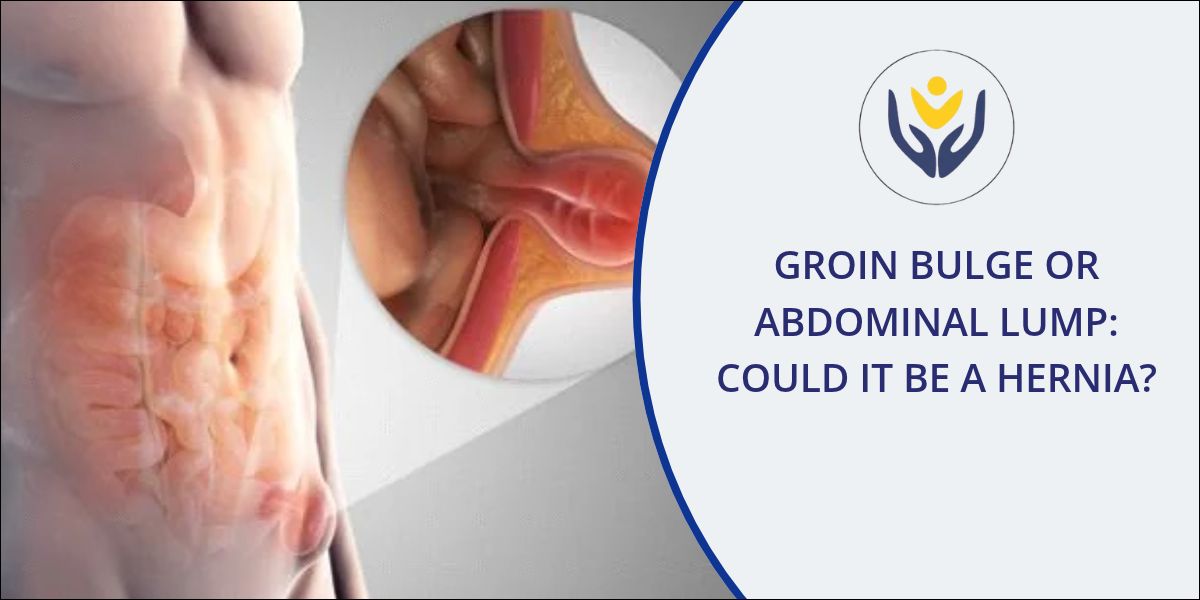
Groin Bulge or Abdominal Lump: Could It Be a Hernia?
A groin bulge or abdominal lump may be a hernia, which happens when part of the intestine or fatty tissue pushes through a weak spot in the muscle wall of the abdomen. A hernia typically appears as a soft swelling that becomes more visible when you stand, cough or strain and may flatten when you lie down. However, not every lump in the groin or abdomen is a hernia. Lymph nodes, fatty lumps, cysts and problems of the testicle can look similar, so an examination by a doctor is the way to find the cause. Sudden severe pain with a hard lump needs emergency care.
This guide explains how a hernia usually looks and feels, which other conditions can cause a lump, which symptoms are warning signs and how a surgeon assesses a bulge.
What Is a Hernia?
The abdominal wall is made of layers of muscle and tissue that hold the organs in place. If a part of this wall is weak or has been opened, for example by a past operation, the contents of the abdomen can push outwards. This forms a hernia. Hernias can appear in the groin, around the navel, in the upper middle abdomen or along a surgical scar.
You can read more about the condition in our guide to the types, causes and symptoms of inguinal hernia.
How Does a Hernia Usually Feel and Look?
- A soft bulge in the groin, near the navel or elsewhere on the abdomen
- A bulge that becomes more obvious on standing, coughing, lifting or straining
- A bulge that may shrink or disappear when you lie down or press on it gently
- A dragging, heavy or aching feeling, which may be worse by the end of the day
- Discomfort or a burning feeling at the site during activity
- In men, swelling that extends into the scrotum
Some hernias cause very little pain, especially early on. A lack of pain does not mean the lump is harmless, so it is still wise to have it checked.
Common Types of Hernia That Cause a Lump
Inguinal hernia
An inguinal hernia appears in the groin, at the upper end of the thigh crease. It is the most common type in men but can also occur in women.
Femoral hernia
A femoral hernia appears slightly lower in the groin, near the upper thigh. It is seen more often in women and carries a higher risk of getting stuck, so it is usually assessed promptly.
Umbilical hernia
This hernia forms at or near the navel. It can occur in adults, particularly with pregnancy, excess weight or fluid in the abdomen.
Epigastric hernia
An epigastric hernia is a small lump in the midline between the navel and the breastbone.
Incisional hernia
An incisional hernia develops through a scar from a previous abdominal operation. It may appear months or years after surgery.
What Else Can Cause a Groin Bulge or Abdominal Lump?
Other conditions that may be mistaken for a hernia include:
- Enlarged lymph nodes: firm, sometimes tender lumps in the groin, often with infection or inflammation in the leg or genital area.
- Lipoma: a soft, painless, slow-growing fatty lump under the skin that does not change with coughing.
- Cyst or abscess: a lump that may be red, warm and tender, sometimes with pus.
- Hydrocele or varicocele: swelling of the scrotum from fluid or enlarged veins.
- Undescended testis: a testis that has not reached the scrotum, which may feel like a groin lump.
- Muscle strain or hematoma: swelling after an injury or heavy lifting.
- Divarication of the abdominal muscles: a midline bulge when tightening the abdomen, often after pregnancy.
Our article on what can be mistaken for a hernia gives more examples.
Warning Signs That Need Urgent Care
Sometimes a hernia becomes stuck (incarcerated) or the blood supply to the trapped tissue is cut off (strangulated). This is an emergency. Go to the nearest emergency department if you have:
- Sudden, severe or rapidly increasing pain at the bulge
- A lump that is hard, tender and cannot be pushed back
- Redness, purple or dark discolouration over the swelling
- Nausea or vomiting, especially with a swollen abdomen
- Inability to pass stool or gas
- Fever, fast heartbeat or feeling very unwell with the lump
You can learn more in our guide on incarcerated and strangulated hernia.
When Should You See a Doctor?
See a doctor soon if:
- You notice a new bulge in the groin, around the navel or on the abdomen
- A lump is growing, painful or interfering with work or exercise
- You have a dragging pain in the groin or scrotal swelling
- A lump appears near an old surgical scar
- You are not sure whether a lump is a hernia
Early assessment helps to confirm the cause and plan the next step before any complication develops.
How Is a Bulge Assessed?
A surgeon will ask when the lump appeared, whether it changes with posture or coughing, if it is painful and about any past surgery, heavy lifting, chronic cough or constipation.
Physical examination: The doctor will usually examine you standing and lying down, and may ask you to cough or strain while feeling the area. Many hernias can be diagnosed on examination alone.
Imaging: If the diagnosis is not clear, or the lump is small or deep, an ultrasound may be advised. A CT scan or MRI may be used in selected cases, for example after previous surgery.
What Treatment Options Are There?
Treatment depends on the type of hernia, your symptoms, your age and your general health.
- Watchful waiting: Some small hernias that cause no symptoms may be observed under medical supervision. Hernias do not heal on their own, and they may grow with time.
- Surgery: Repair is the usual treatment for a hernia that causes symptoms or has a risk of complications. It may be done through open surgery or minimal access techniques such as laparoscopic or robotic surgery, often with a mesh.
- Treatment for other lumps: Lymph nodes, cysts, lipomas and testicular conditions have their own assessment and treatment.
Your surgeon will explain the options, benefits and risks that apply to you. For more information, see our page on hernia treatment in Pune.
Simple Precautions While You Wait for Your Appointment
- Avoid heavy lifting and straining.
- Treat constipation or a persistent cough, which can raise pressure in the abdomen.
- Do not try to push a painful lump back forcefully.
- Do not use belts or binders for long periods unless advised by your doctor.
- Note when the lump appears, how it feels and any symptoms, so you can describe them clearly.
Frequently Asked Questions
Can a hernia go away on its own?
No. A hernia is a defect in the muscle wall and does not heal by itself. Some small hernias may be watched, but they can enlarge over time.
Is a hernia always painful?
No. Some cause only a bulge or mild discomfort. Pain that is severe or sudden, however, can signal a complication and needs urgent attention.
How can I tell a hernia from a swollen gland?
A hernia usually changes with standing, coughing or lying down and feels soft. A swollen lymph node is often firm, may be tender and does not change with posture. An examination is needed to be sure.
Can a hernia occur in women?
Yes. Women can develop inguinal, femoral, umbilical and incisional hernias, particularly after pregnancy or abdominal surgery.
Does every hernia need surgery?
Not every hernia needs immediate surgery, but most symptomatic hernias are repaired. Your surgeon will advise based on your condition.
Which scan is used for a suspected hernia?
Many hernias are diagnosed by examination. Ultrasound is the most common scan used when the picture is unclear, and other scans are used in selected cases.
Consult Dr. Abhijit Gotkhinde in Pune
If you have noticed a groin bulge or abdominal lump, a timely examination can help to confirm the cause. Dr. Abhijit Gotkhinde (MBBS, DNB Surgery, FMAS, FIAGES, FALS Robotics) is a robotic, laparoscopic and laser surgeon in Pune. You can also read more about Dr. Abhijit Gotkhinde.
- Fatima Nagar: A Wing, 1st floor, Parmar Plaza, Fatima Nagar, Wanowrie, Pune 411040.
- Phone: +91 88015 10151.
- Hadapsar: Office no. 8, Aaru Palace, near Shitala Devi Mandir, Subhash Nagar, Chaitanya Colony, Hadapsar, Pune 411028.
- Phone: +91 91751 75065
To book a visit, use the contact page. For severe pain or a lump that cannot be pushed back, go to the nearest emergency department.


